Generative AI for HGCal
Benchmarking generative models as fast simulation for the CMS calorimeter upgrade
In CaloDiffusion we showed that diffusion models can generate calorimeter showers that are nearly indistinguishable from Geant. But that was demonstrated on the CaloChallenge datasets, which are either idealized cylindrical detectors or a simplified slice of ATLAS.
The goal throughout has been to get these models running inside a real experiment. This project is that step: building generative fast simulation for the CMS High-Granularity Calorimeter (HGCal), with deployment in the CMS simulation workflow as the target.
Why HGCal is hard
HGCal is the upgrade that will replace the CMS endcap calorimeters for the High-Luminosity LHC. It is a very complex detector — 47 layers, roughly six million silicon channels, and sensors laid out on an irregular hexagonal grid whose cell sizes and materials change as you move through the different layers.
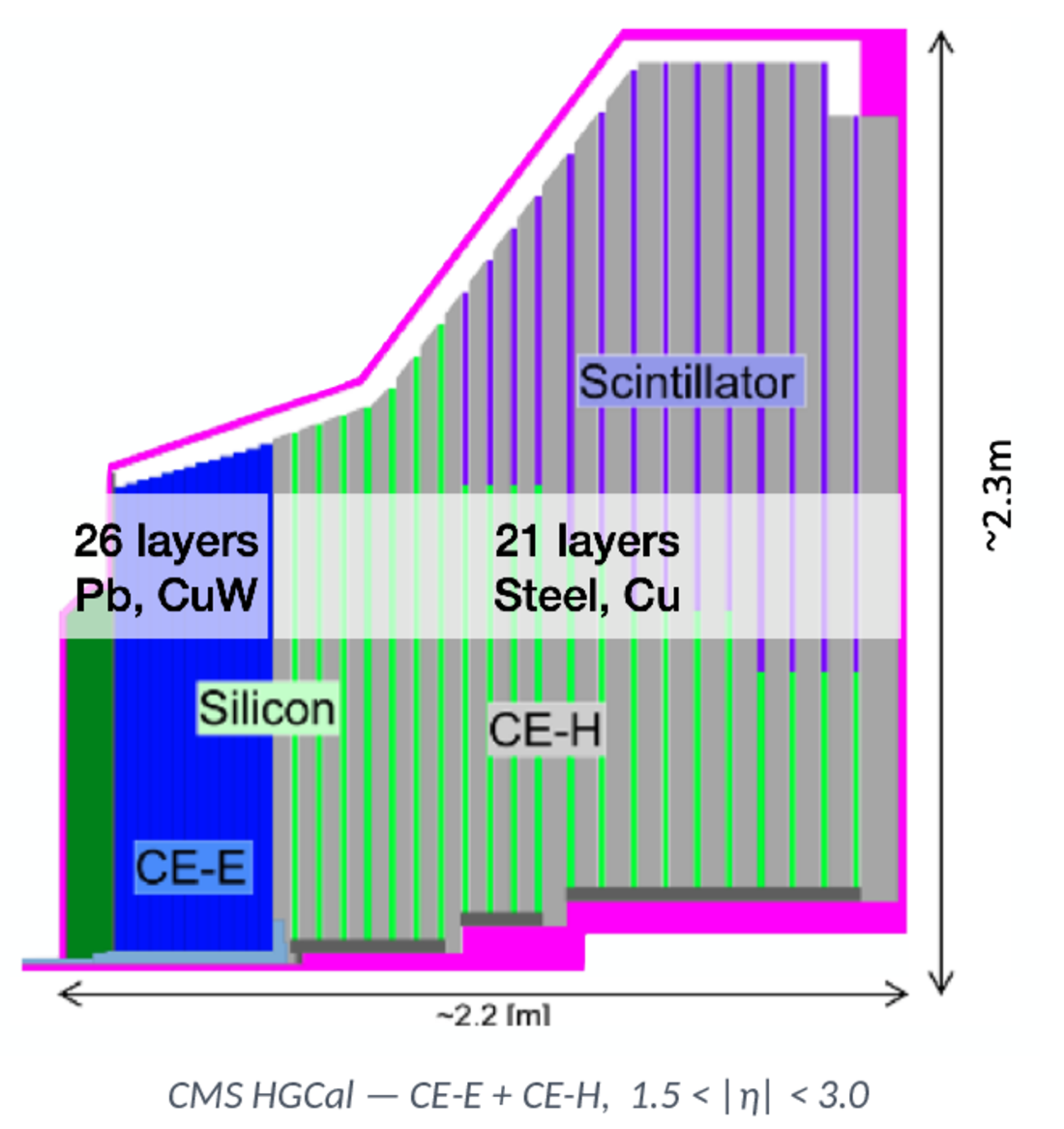
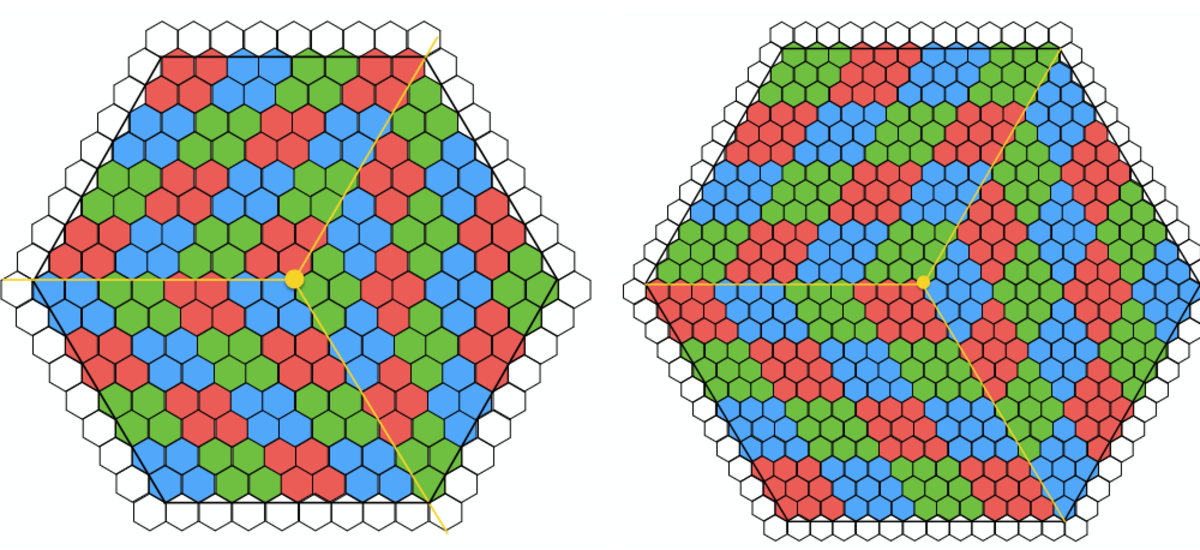
This complexity also makes simulation expensive. Geant4’s cost scales with the detail of the geometry, and HGCal is far more detailed than any calorimeter before it. Meanwhile the simulation share of the CMS computing budget is shrinking, not growing, as reconstruction gets more demanding. So fast simulation will be a requirement in the High Luminosity era. Generative AI can ensure we don’t lose physics performance because of it.
For a sense of the jump in scale: the showers here have roughly 500,000 active cells, about ten times the highest-granularity dataset in the CaloChallenge. That is after restricting to a per-layer region of interest around the shower axis: 25 cm for photon showers, growing from 42 to 127 cm with depth for pion showers.
Raw cell count is not the only challenge; the irregular geometry is also quite difficult to handle. The cells are hexagonal, their sizes vary across the detector, and the layout has none of the regularity that convolutional models are built to exploit. Irregular geometries were tested in the CaloChallenge, but only at much smaller scales of around 500 cells.
A common CMS dataset
Rather than have everyone build their own setup and report incomparable numbers, we put together a common CMS dataset and a shared evaluation framework. The dataset is single particles fired into HGCal in CMSSW: photons and charged pions, one million showers each, split 700k for training and 300k for evaluation, at incident energies from 1 to 1000 GeV sampled log-uniformly.
The evaluation follows the CaloChallenge template. We compute a few hundred physically meaningful features per shower — per-layer energy fractions, centroids, widths, cell occupancy, the transverse profile in rings of hexagonal neighbours — and then compare the generated and Geant distributions using 1D separation power, unbinned Kolmogorov-Smirnov tests, the multivariate FPD and KPD scores, and the AUC of a classifier trained to tell real showers from generated ones.
We plan to release this dataset and evaluation code publicly in the future!
Five models
We trained and evaluated five approaches, deliberately spanning the different generative paradigms in play right now:
- HGCaloDiffusion (Amram & Pedro, 2023) — an improved version of our CaloDiffusion model. A diffusion U-Net on a voxelized representation, carrying over the cylindrical convolutions and GLaM geometry embedding from CaloDiffusion but with a new model for the layer energies and better training/sampling methods.
- HGCaloTrilogy (Jiang et al., 2026) — a next-generation model on top of HGCaloDiffusion, sharing its preprocessing and geometry handling but replacing the generative core with mean-velocity flow transport, a learned Gaussian mixture prior, and a physics-guided loss on high-level observables. This is the line of work that upgrades CaloDiffusion to handle the complexities of HGCal.
- HGCaloDream — flow matching with a vision-transformer backbone, in a two-stage factorization.
- AllShowers — a point cloud representation with conditional flow matching, and a single model handling both particle types.
- GraphCNF — continuous normalizing flows on graphs, chaining a total energy flow, a per-layer graph flow, and a Riemannian flow-matching step for the individual cell energies. Photons only so far.
So how did they do?
Pretty good! Most of the important features of this challenging dataset are well described by multiple models.
The marginal distributions are in good shape. Total energy response, shower centroids and widths, and the shape as a function of depth are all reproduced closely by most of the models.
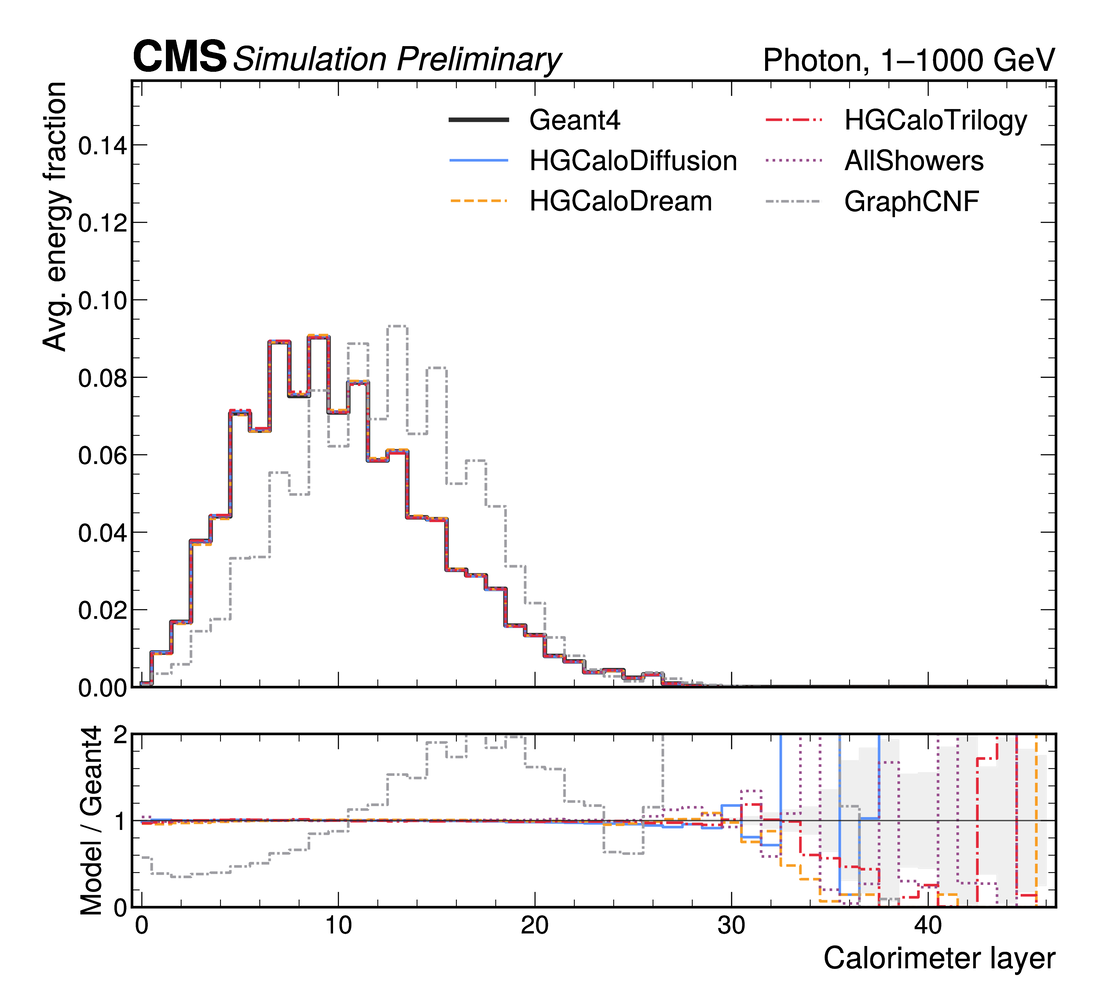
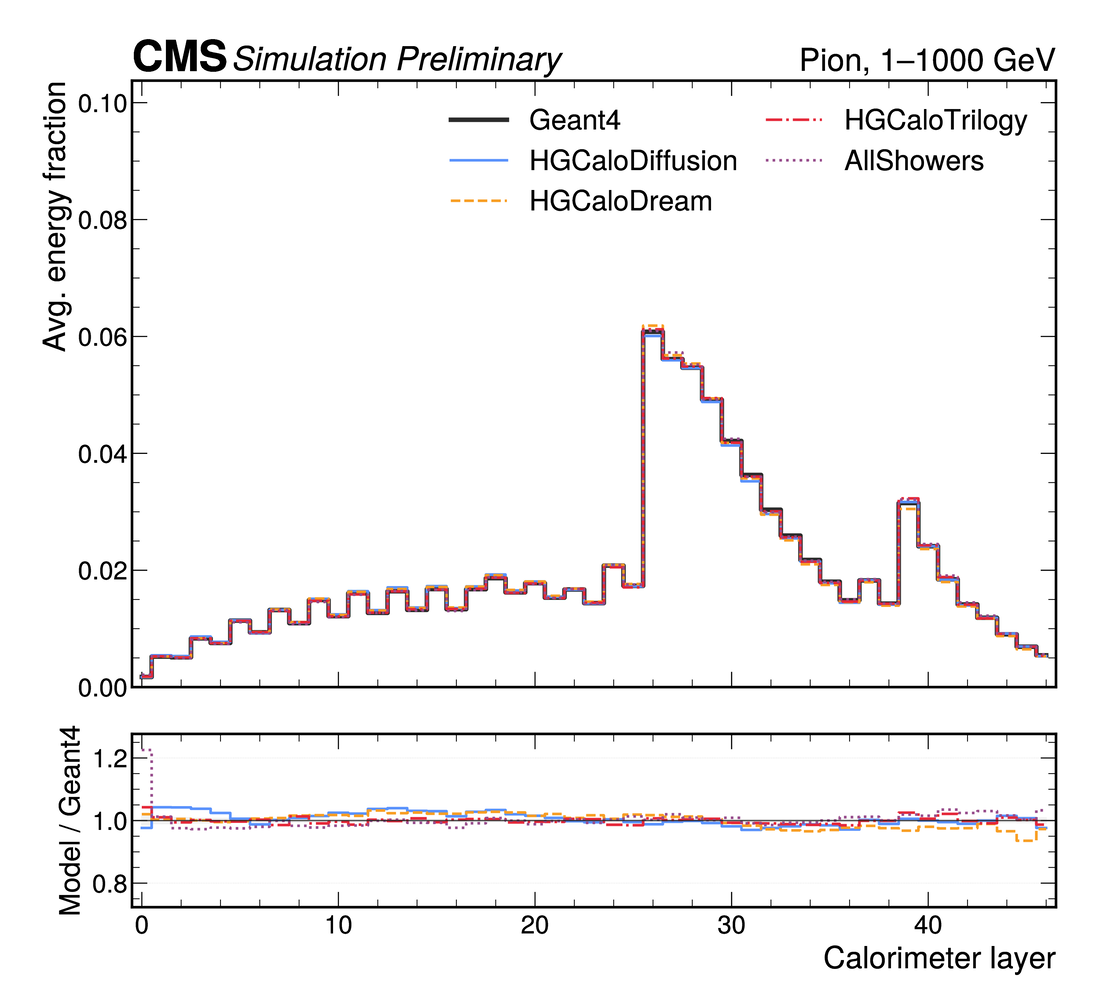
Zooming in on a single layer tells the same story, and also shows where it starts to break down. Layer 30 sits well inside the hadronic section, where pion showers are at their broadest and messiest.
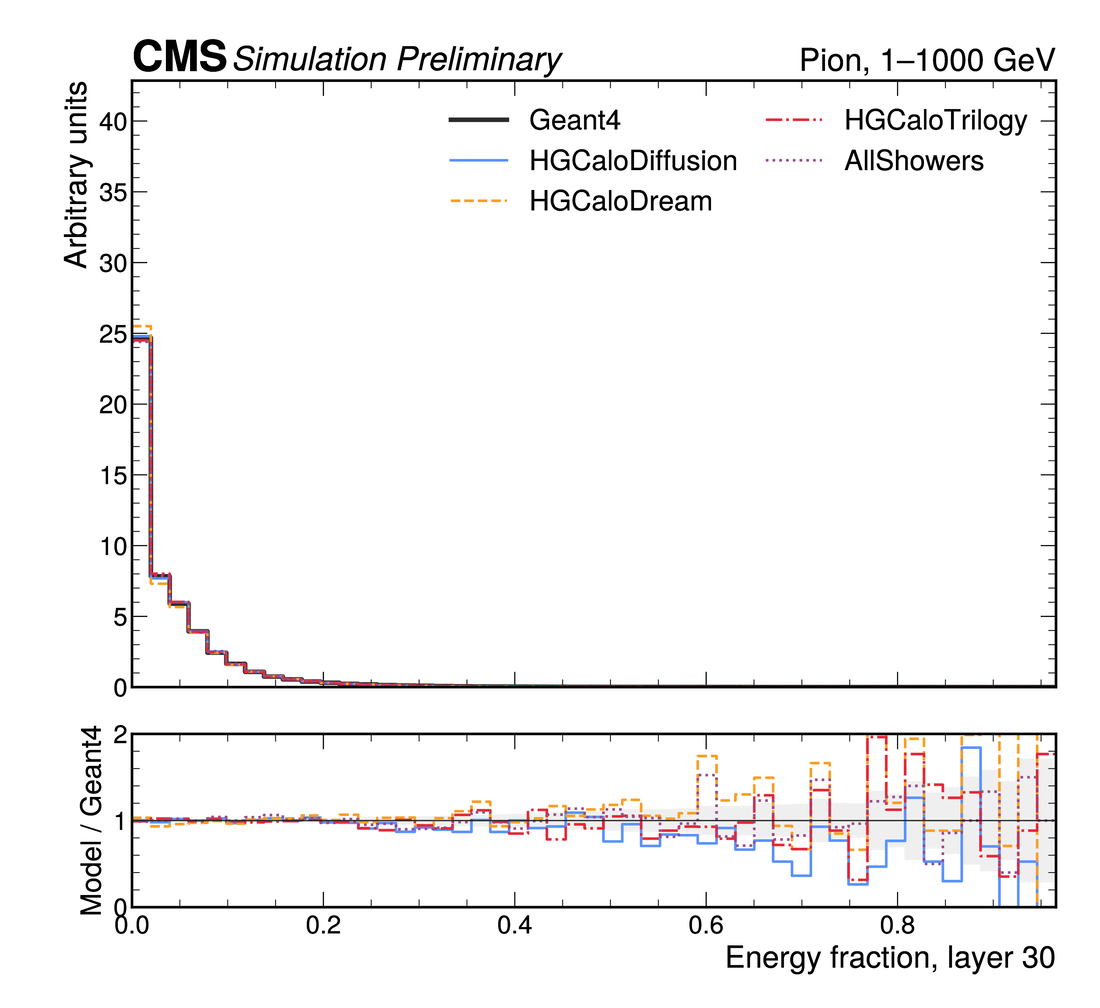
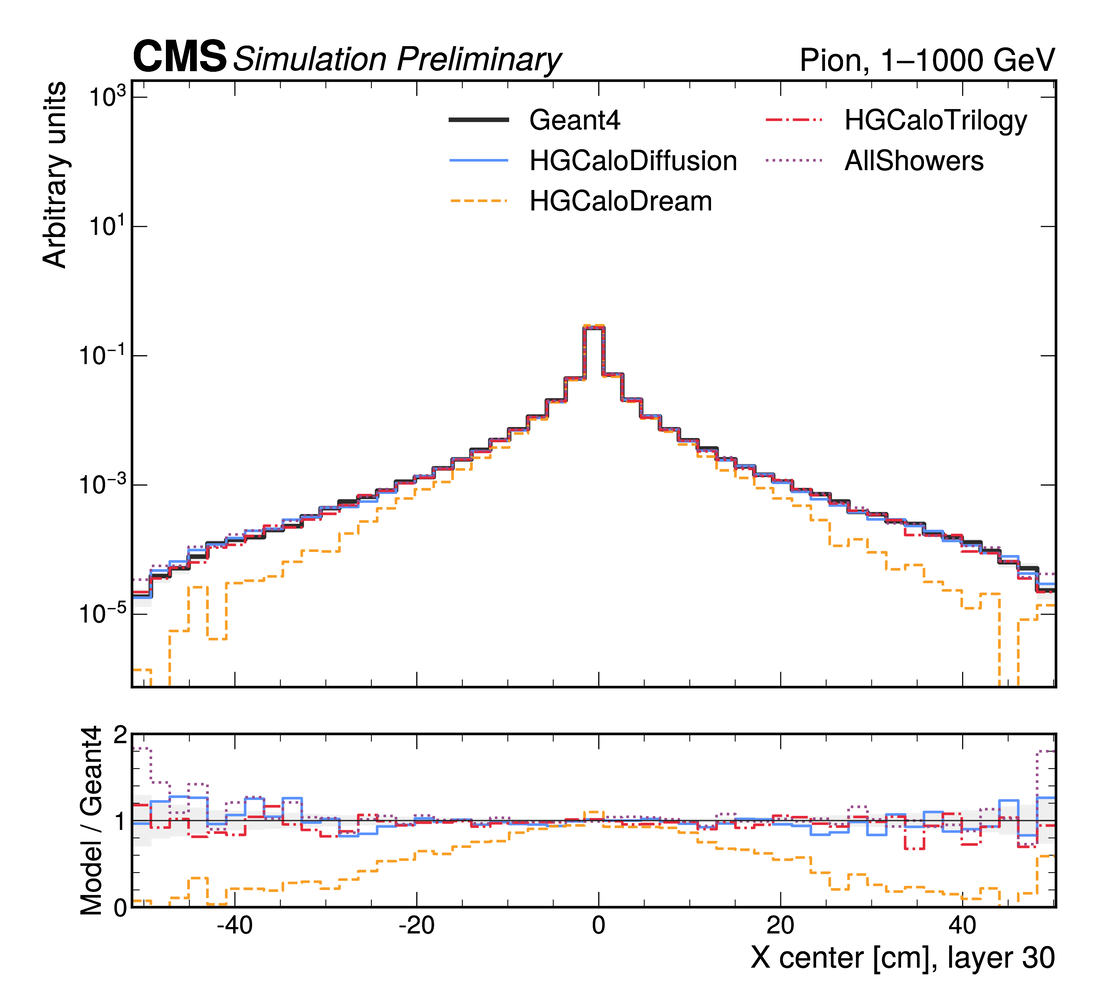
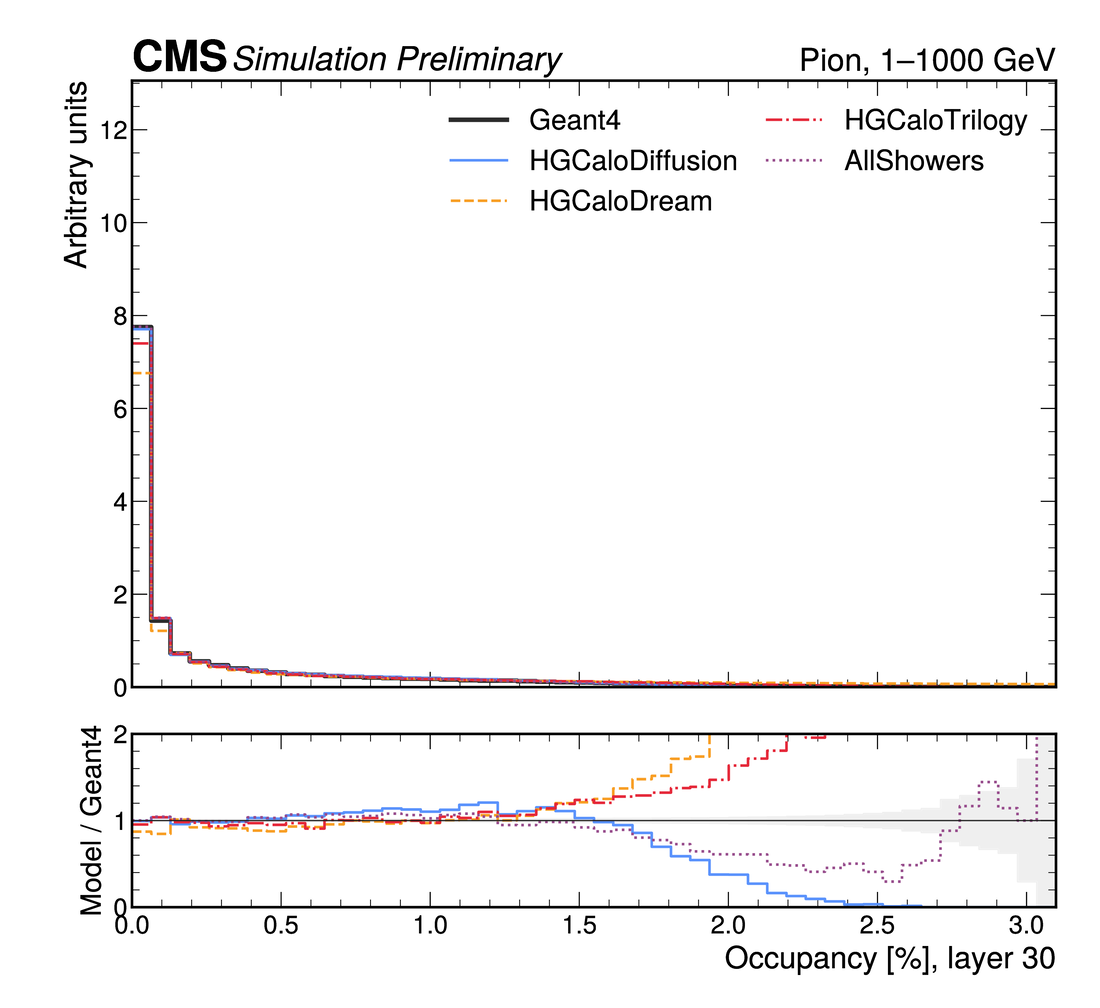
The multivariate metrics, which are sensitive to correlations between features that the one-dimensional distributions miss, show good performance but with room for improvement. No model yet reaches Geant-Geant indistinguishability. HGCaloDream, the best model on the photon dataset, reports a classifier AUC of \(\sim\) 0.56. On the more challenging pion dataset HGCaloTrilogy and AllShowers are the best, at AUCs of \(\sim\) 0.65. These values are not far from full indistinguishability (AUC = 0.5).
There is also no single winner: the best model for pions is not the best for photons, and within one particle type one model will lead on bulk shape while another leads on width and occupancy. The architectures have complementary strengths, and it is too early to consolidate around one.
What’s next
This is a first demonstration that generative models can actually handle the complexities of CMS HGCal. Further evaluation will be needed to assess the computational performance of the models and to validate them on downstream physics observables. However, these promising early results set us on track to deploy these models in the HL-LHC era, with a significant benefit to the physics program of CMS.
I am leading this effort within CMS, coordinating the teams behind the different models along with the dataset and evaluation framework that lets us compare them on equal terms.
Results so far are public as a CMS Detector Performance note, CMS-DP-2026-049, with more detail on the public TWiki.
A full paper describing the dataset, the models, and the evaluation in detail is in preparation! CMS members can follow the analysis here.