Foundation Models for Physics
Pre-training on real LHC data, and how physics data scales
Some of the most dramatic advances in AI over the last few years have come from foundation models: enormous neural networks pre-trained on huge piles of data, which can then be adapted (“fine-tuned”) to a whole range of downstream tasks. The large language models behind ChatGPT are the famous example — a single model is trained on a big chunk of the internet, and that same model can then be specialized to write code, answer questions, or translate languages. The magic is that the model learns a general-purpose representation of its data during pre-training, so the downstream tasks get a huge head start instead of having to learn everything from scratch.
Particle physics would seem like an ideal place for this idea. The LHC produces staggering amounts of complex data, and we constantly build specialized models for individual tasks — tagging jets, generating simulated events, separating signal from background. If we could pre-train one big model that understands the general structure of collider data, every one of those downstream tasks could benefit. But bringing foundation models to physics raises two basic questions that I’ve worked on with my collaborators:
- Where does the pre-training data come from? Foundation models are hungry for data, and physicists usually train on simulation, which takes computational resources to produce and is never a perfect match to reality.
- Do the “scaling laws” that make foundation models work even hold for physics data? In language, model performance improves in a remarkably predictable way as you add more parameters, data, and compute. Is the same true for collider physics?
Unlocking real LHC data: Aspen Open Jets
The first question is really about data. It turns out the LHC experiments have already released large amounts of real collision data to the public — but it’s stored in complicated experiment-specific formats that are very hard for anyone outside the collaboration to use. This data has been largely untapped for machine learning.
In the first project (Amram et al., 2025), my collaborators and I processed a huge sample of CMS open data into a clean, machine-learning-friendly format we call Aspen Open Jets (AOJ). It contains roughly 180 million jets — sprays of particles from the LHC’s most common collisions — making it by far the largest dataset of its kind, and crucially it is built from real data rather than simulation. We released it publicly so the whole community can use it. This is only a small fraction of the data collected by CMS, so this could be scaled up quite a bit further if CMS decided to release more data publicly.
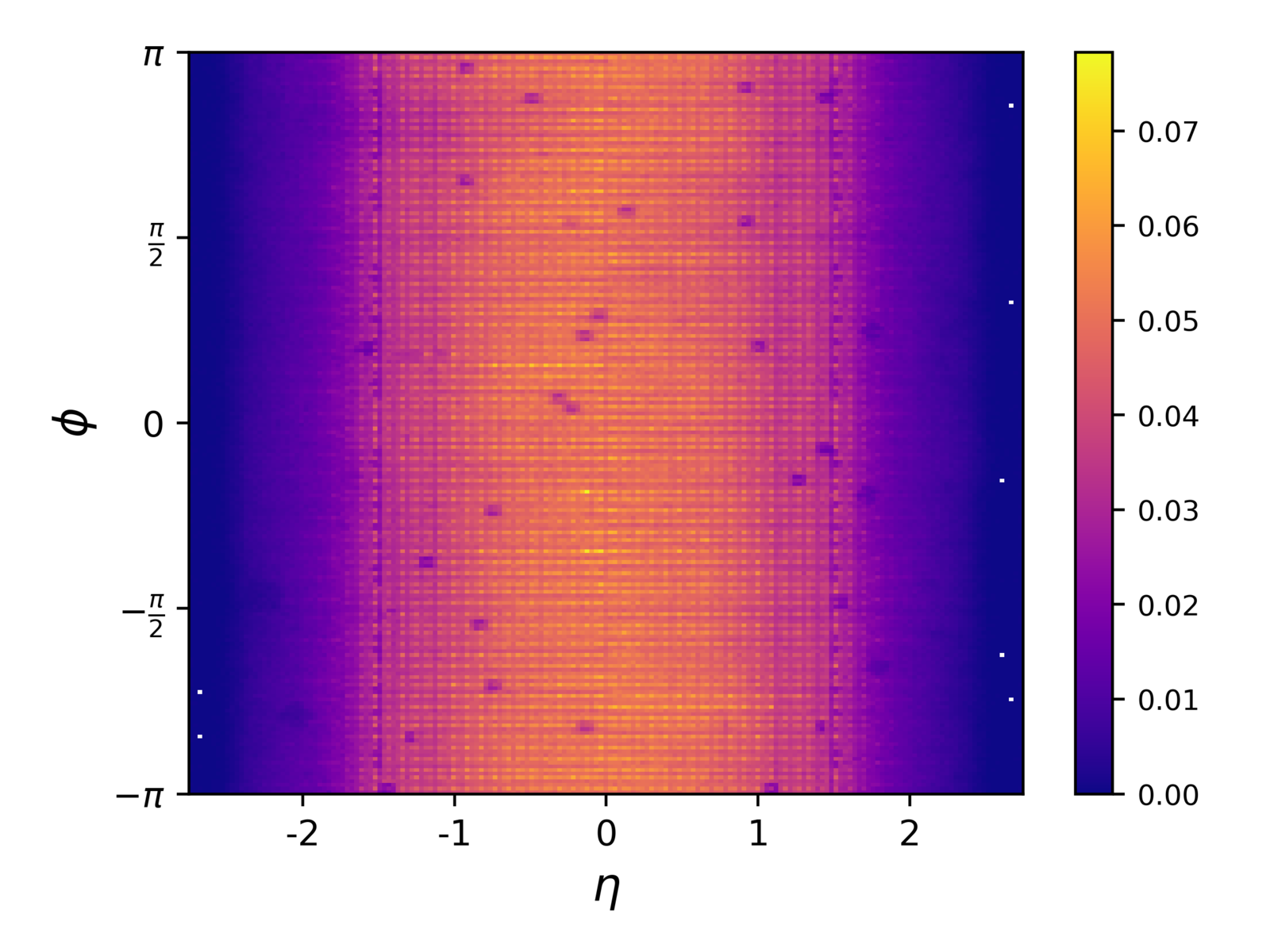
One nice thing about this dataset is that you can literally see the CMS detector in the raw data. If you plot where the particles land in the detector, the grid-like segmentation of the calorimeter cells, the boundaries between detector regions, and even individual dead readout channels are all visible.
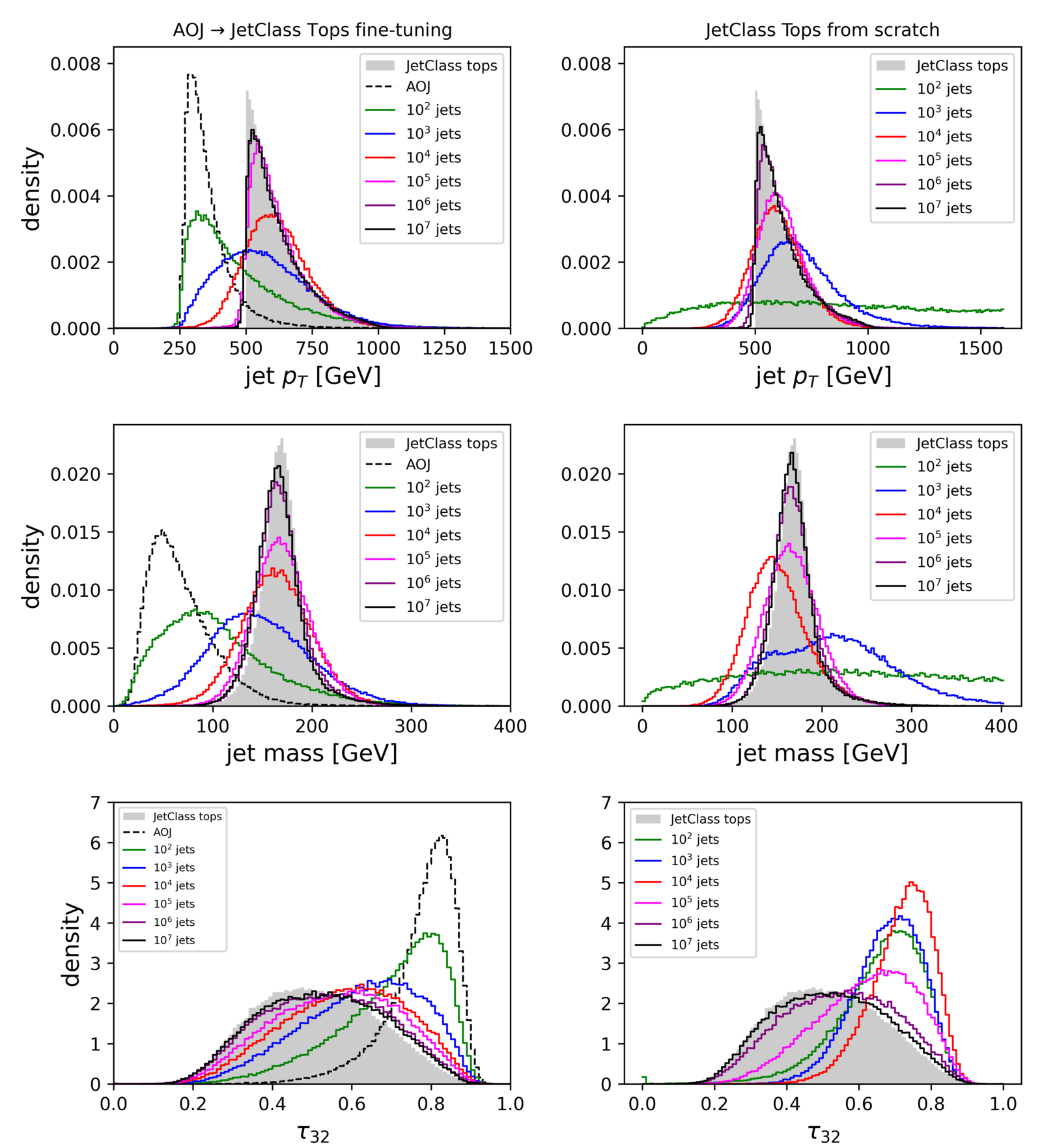
To show this data is actually useful for foundation models, we pre-trained one on it. We used a model called OmniJet-α, which treats a jet much like a language model treats a sentence: each particle is converted into a “token,” and the model learns to predict the next token in the sequence. After pre-training on the 180M real jets, we fine-tuned the model on a much harder, deliberately mismatched task — generating simulated jets of a different type (top-quark jets) with different kinematics. This is a big “domain shift”, and therefore an interesting test of the value of pre-training.
The pre-training paid off. The pre-trained model reached high-quality generation with far less fine-tuning data than a model trained from scratch — often about 10 to 100 times fewer jets to reach the same quality. Even though it was pre-trained on real QCD jets and asked to generate simulated top jets, it smoothly adapted, essentially “morphing” what it already knew about jets to fit the new task. A model starting from scratch had to relearn everything and needed far more data to catch up.
Do physics models scale like language models?
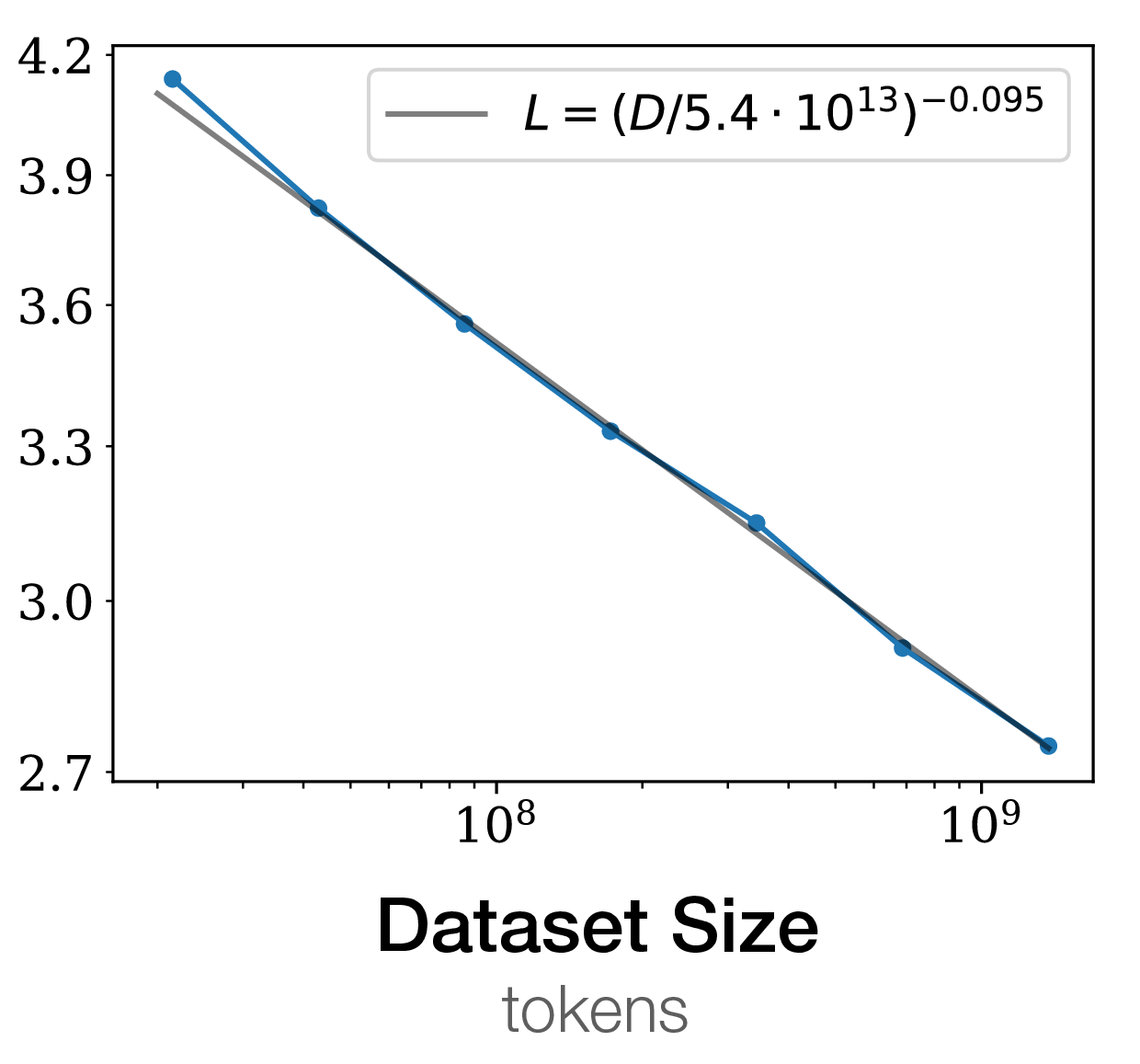
The second question is more fundamental. The reason people pour billions of dollars into ever-larger language models is the discovery of neural scaling laws: as you increase the model size, the amount of training data, and the compute, performance improves in a smooth, predictable, power-law fashion. These laws are what tell you it’s worth building a bigger model — you know roughly what you’ll get. But there was no guarantee that collider data, which is very different from human language, would behave the same way.
In a follow-up project (Amram et al., 2026), mostly led by collaborators, we set out to measure the scaling laws for jet generation for the first time. The results were a mix of reassuring and surprising. When we scaled up the model size, we did recover the clean logarithmic scaling behavior familiar from language models: bigger models reliably generate better jets. But when we scaled up the dataset size and compute, the improvement was much weaker than in language: the models saturate quickly, hitting a plateau where extra data barely helps.
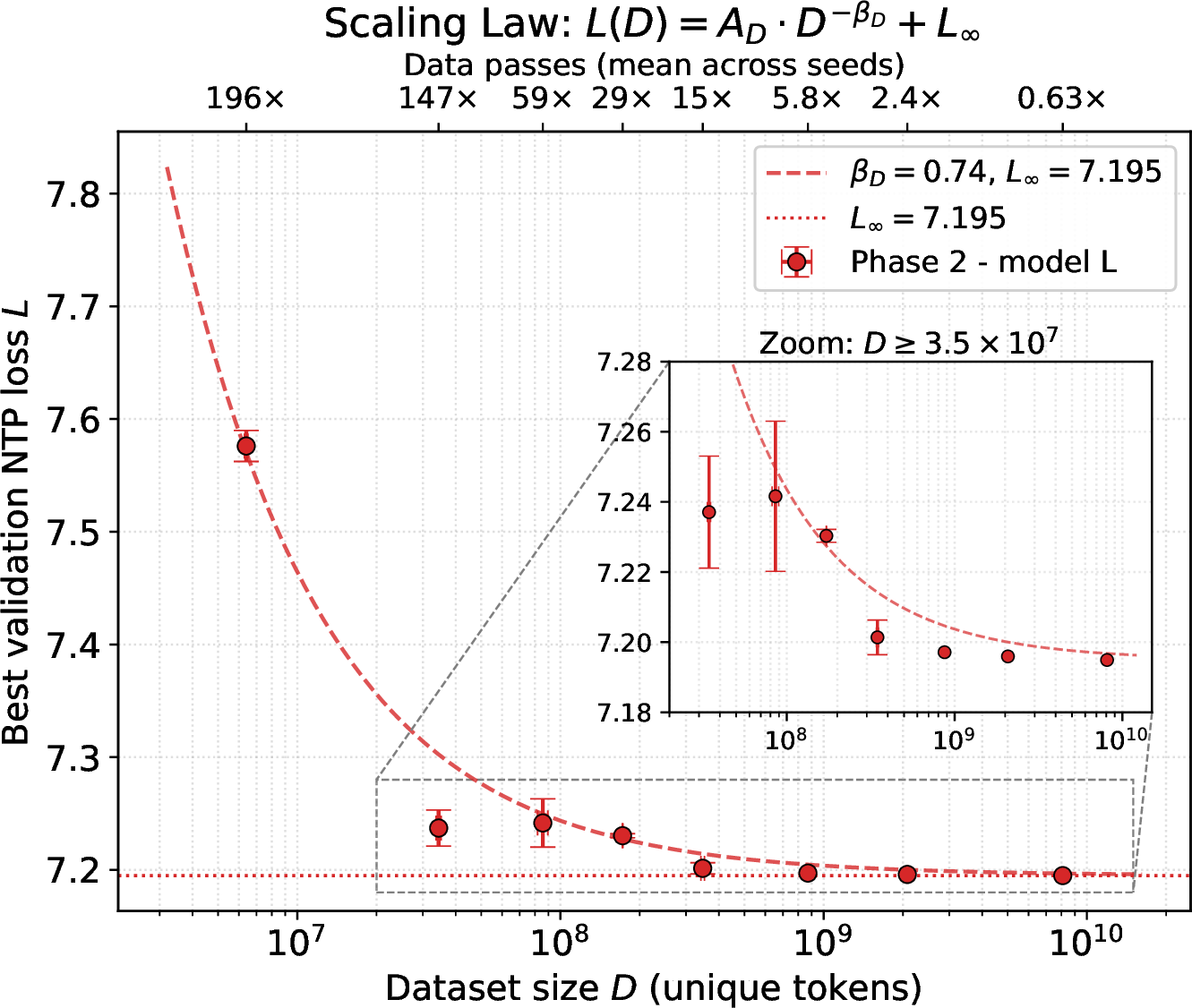
To make sense of this, we introduced the idea of a “learnable window.” Intuitively, a jet is far more random than a sentence: it’s the product of the strong nuclear force spraying out particles in an intrinsically stochastic way, so beyond a certain point there simply isn’t more structure left to learn from additional examples. The model quickly absorbs the learnable structure and then plateaus, because the rest is irreducible randomness. This appears to be a real difference between generative modeling of physics data and next-word prediction in text, and it has serious implications for how we might approach building a foundation model in physics.
If the saturation we observed is real, we need to rethink how we might train a physics foundation model. Copying the next-token-prediction task from the language domain, which many assumed would work, may be a dead end. So either we need a different unsupervised training objective, which actually scales as we would hope and can be deployed on the unlabeled data collected by our experiments. Or we use supervised pre-training objectives, which have been shown to exhibit nice scaling behavior, but this may suffer from the limited quality of our simulation, and bias us toward the known physics models we choose to simulate.
Where this is going
Taken together, these projects chip away at two of the practical barriers to building foundation models for physics: they provide a large, real-world dataset to pre-train on, and they map out how much we should actually expect to gain from scaling. Foundation models are still in their early days in our field. Scaling laws have clearly proved extremely powerful in language, and we should figure out how they can be harnessed for particle physics. I would also like to understand what qualitatively new capabilities a successful foundation model could achieve.
You can read more in the Aspen Open Jets paper (Amram et al., 2025) and the scaling laws paper (Amram et al., 2026). The AOJ dataset is public for anyone to use.